

How SMP Can Help Women with Hair Loss
Do you constantly think about your hair?
Your part is widening. Your scalp is becoming increasingly visible. You try to use volume, powder, or a different hairstyle to conceal something that simply wasn't an issue before.
And at some point, it’s no longer just about hair.
It becomes about where you’re standing, how the light hits, whether someone is looking down at your head, or how your hair looks in photos.
If this sounds familiar, you’ve come to the right place.
SMP can visually minimize visible scalp and make your existing hair look thicker again.
It’s not just about hair.
You might recognize these situations:
-
you constantly check your hair part in the mirror
-
wet or greasy hair makes you instantly nervous
-
bright overhead lighting makes your scalp look even more visible
-
you avoid certain hairstyles
The goal of SMP is not for anyone to notice your pigmentation, but rather for you to have to think less about your scalp.
WHAT SMP CAN CHANGE FOR YOU:
MORE DENSITY – WITHOUT MORE HAIR
SMP does not make new hair grow.
Instead, tiny pigment dots are placed between your existing hair. This visually reduces the contrast between your scalp and your hair.
As a result:
your parting can appear narrower
visible scalp is less noticeable
your hair looks fuller overall
Your existing hair remains completely intact.
"But won't you see the dots afterwards?"
This is likely one of the most important questions for women.
A density treatment is not about imitating a shaved look.
The pigment is applied so finely between your existing hair—and matched to your hair color, skin tone, and density—that it blends visually into the overall look.
The goal isn't for people to think, "She’s had SMP," but rather, "Her hair looks fuller somehow."
Who is SMP suitable for?
SMP can be particularly appealing if:
-
your parting is becoming increasingly visible
-
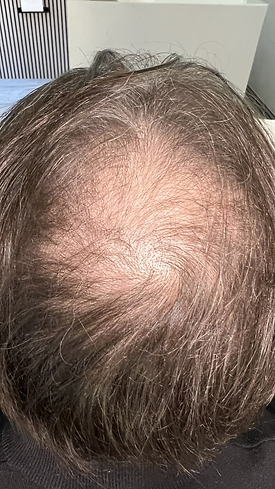
your hair on the crown has thinned significantly
-
your scalp is clearly visible through your existing hair
-
you are experiencing diffuse or hereditary hair loss
-
you want the appearance of greater density without having to cut your hair short.


MY APPROACH.
WHY SHÆDE?
I’m Bianca, and I specialize in scalp micropigmentation and hair loss solutions, among other services.
Through my work, I see time and again just how much visible hair loss can weigh on women in their daily lives.
That’s why my goal isn’t simply to apply pigment to the scalp; it’s about creating a result that looks natural and blends seamlessly with your existing hair.
I use the Soli Dots & Twin Dots technique and completed my SMP training at Scalp Studio Sweden.
How much does SMP cost for women?
The price depends on the size of the area to be thickened and the desired level of density.
The Ludwig Scale below serves as a rough guide. This classification is for orientation purposes only; I can only assess your actual status based on your individual situation.

TYP I
Slight thinning in the crown area. The scalp is slightly visible, while the hairline generally remains intact.

TYP II
Significant hair loss on the crown. The part visibly widens, and density clearly decreases.

TYP III
Severe thinning throughout the entire crown area. The scalp is clearly visible.
YOUR PATH TO VISUALLY THICKER-LOOKING HAIR:
Step 1:
planning
We examine the area, discuss your desired result, and match the color and density to your hair.
Step 2:
The Pigmentation
The pigment dots are delicately placed between your existing hair. The result is built up gradually over several sessions.
Step 3:
Fine-tuning
After healing, density, transitions, and intensity are further refined as needed.
You don't want to keep checking his part all the time anymore?
After each session, the skin requires a few days to heal. Slight redness may occur. You will receive detailed aftercare instructions for the post-treatment period. Over the course of 1–2 follow-up appointments, we will perfect the density, color intensity, and transitions—to achieve the most natural-looking result possible.

MY QUALITY NETWORK


